SEO VS. AEO: What's the Difference and Why Your Event Business Needs Both
Published
Feb 12, 2026
Reading Time
11 min
Category
AI Search
bolt
The short version
SEO gets your event company website ranked on Google's list of links. AEO makes your company the direct answer when a client asks an AI assistant for a vendor recommendation. With 65% of searches now ending without a click (SparkToro, 2025), event service companies need both strategies working together.
What Is the Difference Between SEO and AEO?
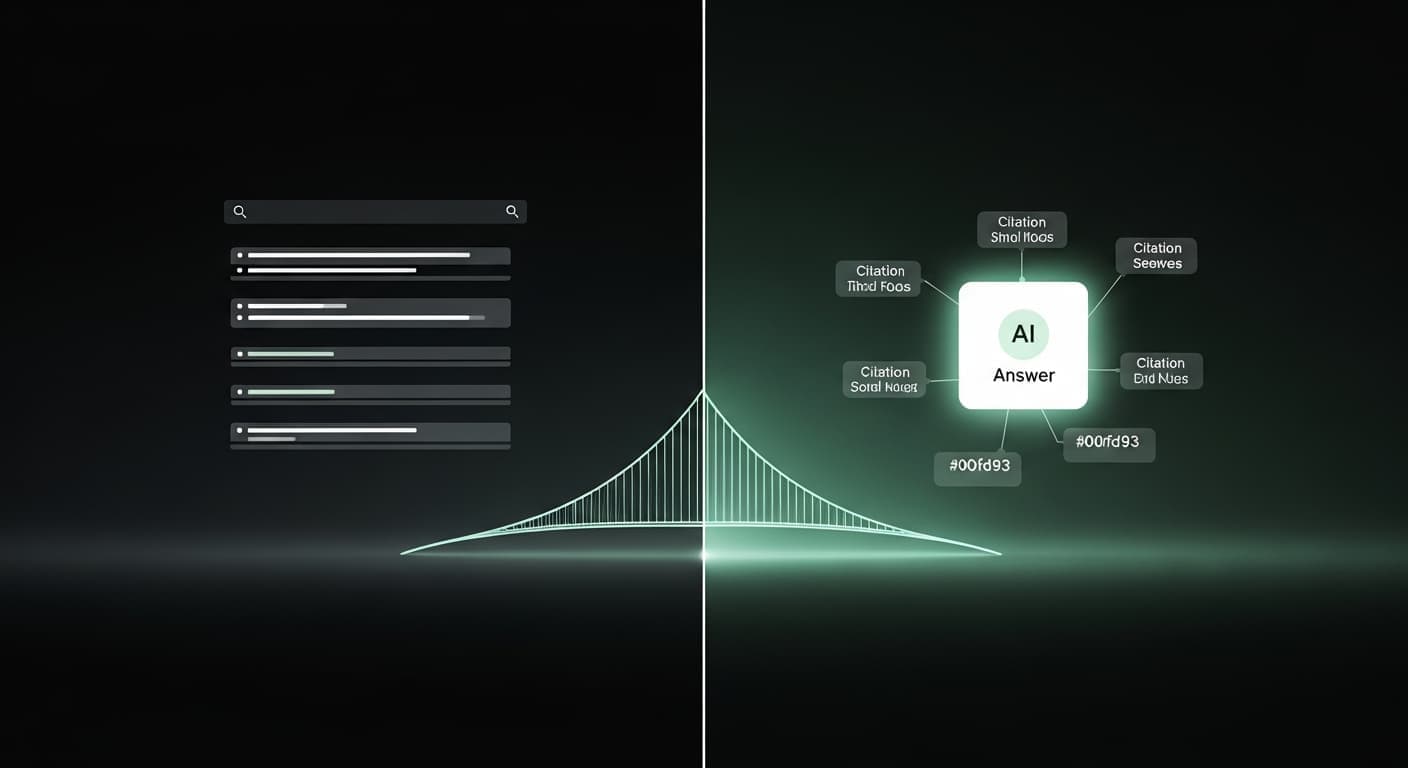
SEO (Search Engine Optimization) optimizes your website to rank higher in traditional search engine results — the list of blue links on Google. AEO (Answer Engine Optimization) optimizes your content to be cited as the direct answer by AI-powered platforms like ChatGPT, Perplexity, Google AI Overviews, and voice assistants.
The distinction matters because search behavior is splitting in two. Some people still scroll Google results. Increasingly, others ask an AI assistant and act on the first answer they receive. Event companies that only invest in SEO are invisible to the second group.
How Do SEO and AEO Compare Side by Side?
The following table breaks down the key differences across every dimension that matters for event marketing:
| Dimension | SEO | AEO |
|---|---|---|
| Primary goal | Rank on page 1 of Google | Be the answer AI provides directly |
| Target platform | Google, Bing search results | ChatGPT, Perplexity, Google AI Overviews, Siri, Alexa |
| Content format | Keywords in headings, meta tags, body text | Question-answer pairs, schema markup, atomic paragraphs |
| Success metric | Rankings, organic traffic, CTR | AI citations, featured snippets, brand mentions in AI responses |
| Link importance | Critical — backlinks are a top ranking factor | Moderate — brand mentions and citations matter more |
| Schema markup | Helpful but optional | Essential — the primary way AI systems understand your content |
| Content style | Long-form, keyword-optimized, comprehensive | Answer-first, structured, extractable by machines |
| User behavior | User clicks through to your website | User may never visit your site — they get the answer from AI |
| Conversion path | Click → landing page → purchase | AI recommendation → direct search → purchase |
| Time to results | 3–6 months for meaningful rankings | Faster for well-structured content on emerging queries |
| Competitive landscape | Mature — most niches are competitive | Emerging — most industries (especially events) are wide open |
Why Can't Event Companies Just Pick One?
Because attendees and sponsors discover events through both channels, and the two strategies reinforce each other.
SEO captures the person who Googles "tech conferences in Austin 2026" and clicks through to your website. AEO captures the person who asks ChatGPT the same question and gets your event name in the response — without ever visiting Google.
Here's the compounding effect: strong SEO performance (rankings, backlinks, authority) signals to AI systems that your content is trustworthy, making AI more likely to cite you. And when AI recommends your event, it generates branded searches ("What is [Your Event]?") that boost your SEO metrics. The two strategies create a flywheel.
What Does the Data Say About the Shift?
The numbers show a clear trend toward AI-mediated discovery:
- 65% of Google searches end without a click (SparkToro, 2025). More than half of all search activity never results in a website visit.
- ChatGPT processes over 2 billion queries daily across 800 million weekly active users (OpenAI, October 2025). That's a search engine–scale audience.
- AI search visitors convert at 4.4x the rate of traditional organic visitors (Semrush, 2025). When an AI recommends your event, the person who follows up is far more likely to buy a ticket.
- Gartner predicts 25% of organic traffic will shift to AI chatbots and virtual agents by end of 2026. This isn't speculative — it's happening now.
- Only 20% of organizations have started AEO, despite 70% believing it will significantly impact their strategy within 1–3 years. In the events industry, the adoption rate is effectively zero.
How Do You Implement SEO and AEO Together?
The good news is that SEO and AEO share a common foundation. Much of the work you do for one benefits the other. Here's how to implement both:
Start with Structure
Add JSON-LD schema markup to every page. Event schema, Organization schema, FAQ schema, and BreadcrumbList schema serve both SEO (rich results in Google) and AEO (machine-readable content for AI extraction). This is the highest-leverage action because it improves both channels simultaneously.
Write Answer-First Content
Traditional SEO content buries the answer after a long introduction. AEO-optimized content leads with a direct answer in the first 30–60 words, then expands with supporting detail. This format also wins Google featured snippets, meaning it's better for SEO too.
Build Question-Based Content Hubs
Create hub pages for your core topics (your event, your industry, your services) with spoke articles answering specific questions. Use question-format headings ("How much are tickets for [Event]?") that match how people query both Google and AI assistants.
Invest in Brand Mentions
SEO values backlinks. AEO values brand mentions — even without a link. Getting your event mentioned in industry publications, podcasts, and forums benefits both. The mention builds AI recognition; if it includes a link, it builds SEO authority too.
Track Both Channels
Use Google Search Console and GA4 for SEO metrics. For AEO, manually test your visibility monthly by querying ChatGPT, Perplexity, and Google AI Overviews with questions your audience asks. Track whether you're cited, how accurately, and what competitors appear instead.
What Should Event Companies Prioritize First?
If your website has no SEO foundation (no schema, poor technical health, no content strategy), start with SEO basics. You need a well-structured, fast, crawlable website before AEO can work.
If your SEO fundamentals are solid, shift priority to AEO. The competitive window for event-industry AEO is wide open. No event-focused agency is producing AEO content at scale. The first movers will establish topical authority that compounds over time.
For most event companies, the answer is both — simultaneously. The structural work (schema markup, content formatting, question-based architecture) serves both strategies. Start there, then layer in channel-specific tactics.
The Bottom Line
SEO and AEO are not competing strategies. They're two layers of the same system. SEO captures people who search and click. AEO captures people who ask and act. Event companies that implement both will dominate discovery across every channel — traditional search, AI assistants, voice queries, and whatever platform comes next. The ones that only do SEO will watch their visibility erode as more search activity moves to AI-powered answers.
Keep reading
All postsarrow_forwardAI SearchApr 12, 2026
Voice Search: Getting Found When Clients Ask 'Who's the Best Event Company Near Me?'
When a corporate client asks Siri 'Find me an event planner near me' or tells Google Assistant 'Who's the best AV rental company?' — the assistant picks one answer. Voice search optimization ensures that answer is your event company.
AI SearchApr 3, 2026
How AI Overviews Are Changing How Clients Find Event Vendors
Google AI Overviews now appear at the top of search results for many event-related queries, replacing the traditional list of blue links with an AI-generated summary. For event companies, this means the way clients discover vendors is fundamentally shifting — and most event businesses aren't prepared.
SEOMar 25, 2026
How to Rank for 'Event Production Company Near Me'
'Event production company near me' is one of the highest-intent local search queries in the event industry — someone typing this is actively looking to hire. Here's exactly how to make sure your company appears at the top of both Google's local pack and AI recommendations.