7 Features Every Event Company Website Needs to Win Clients
Published
Dec 10, 2025
Reading Time
8 min
Category
Web Design
bolt
The short version
The difference between an event company website that generates inquiries and one that gets ignored comes down to seven specific features. Portfolio galleries, case studies, and clear CTAs are just the start — here's the complete list.
What Makes an Event Company Website Actually Work?
Most event company websites look fine but don't generate business. They're digital brochures — pretty but passive. A website that wins clients does seven things that most event companies skip.
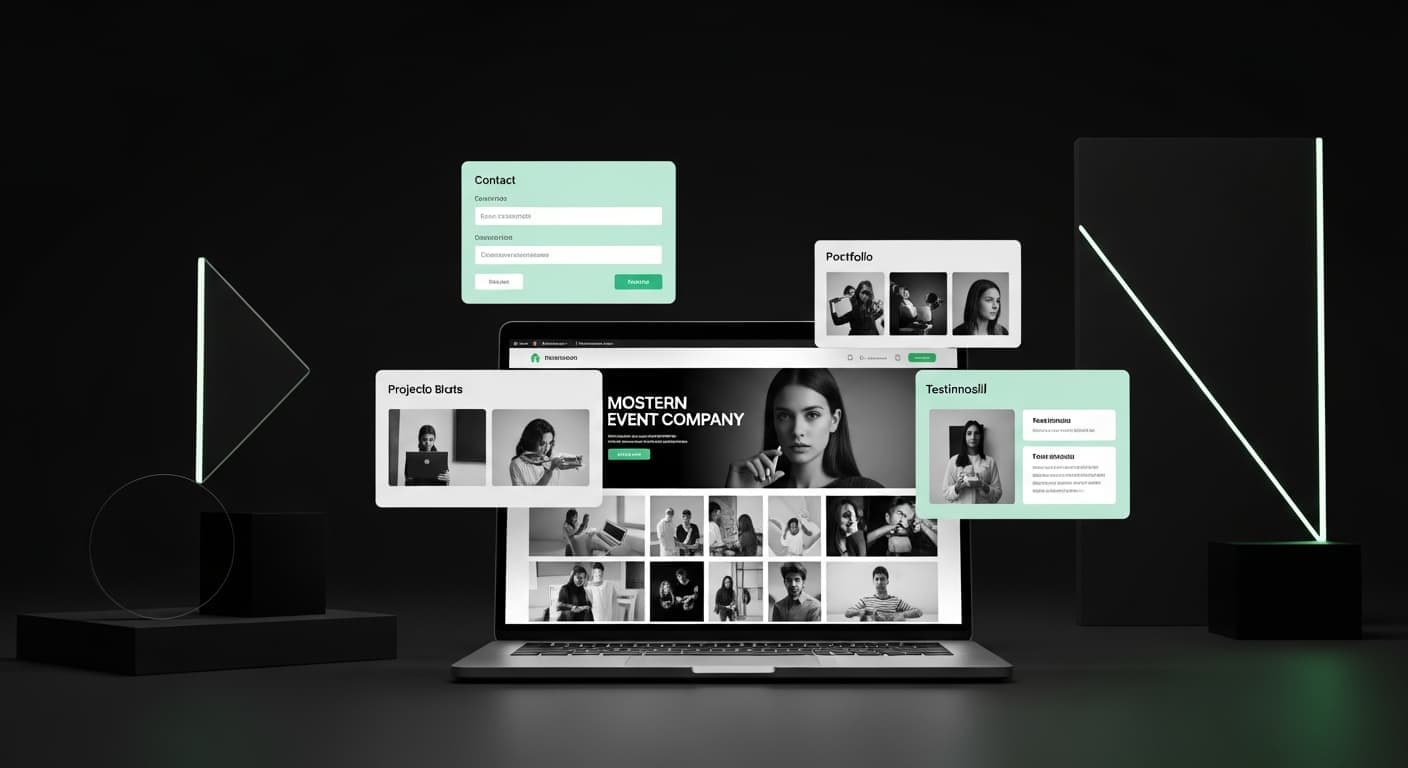
1. Portfolio That Tells Stories, Not Just Shows Photos
A grid of event photos isn't a portfolio — it's a photo dump. Clients want to see the problem you solved, the challenge you overcame, and the result you delivered. Each project should be a mini case study: the client's brief, your approach, the outcome, and ideally a testimonial.
Structure each portfolio entry with: project overview (2-3 sentences), the challenge, your solution, key metrics (guest count, budget range, venue), and 5-8 curated images. This format gives clients confidence that you can handle their specific situation.
2. Clear Service Pages with Pricing Signals
Don't make prospects guess what you offer or what it costs. Create dedicated pages for each service (production, planning, design, rentals) with enough detail that a client can self-qualify. You don't need exact pricing, but ranges like "Corporate events typically start at $X" save everyone time.
3. Social Proof Above the Fold
Client logos, review ratings, or a testimonial should be visible without scrolling. When a corporate event manager lands on your site, they need immediate validation that companies like theirs trust you. A row of recognizable client logos does this in one second.
4. Mobile-First Design
Over 70% of your prospective clients will first see your website on their phone — often while commuting, between meetings, or at an event. If your portfolio images load slowly, your contact form is hard to tap, or your text is too small, you've lost them. Mobile isn't an afterthought; it's the primary experience.
5. Prominent Contact / Inquiry Form
Every page should have a clear path to contact you. A persistent "Get a Quote" button in the header, a contact form on every service page, and a phone number that's tappable on mobile. The moment someone decides they want to talk, the path should be one click — not a hunt.
6. Blog or Insights Section
A blog builds SEO authority and demonstrates expertise. Event companies that publish regularly — project recaps, industry insights, how-to guides — rank higher on Google and give AI systems content to cite. Even one post per month makes a meaningful difference over a year.
7. Schema Markup and Technical SEO
The invisible features matter most for discovery. Organization schema tells Google and AI what your company is. LocalBusiness schema powers "near me" searches. FAQ schema captures question-based queries. Most event company websites have none of this — which means most are invisible to both Google and AI assistants.
The Bottom Line
A website that wins clients isn't about fancy design — it's about removing friction between "I need an event company" and "I'm reaching out to this one." These seven features create that path. If your current site is missing more than two of them, it's costing you contracts.
Keep reading
All postsarrow_forwardAI SearchApr 12, 2026
Voice Search: Getting Found When Clients Ask 'Who's the Best Event Company Near Me?'
When a corporate client asks Siri 'Find me an event planner near me' or tells Google Assistant 'Who's the best AV rental company?' — the assistant picks one answer. Voice search optimization ensures that answer is your event company.
AI SearchApr 3, 2026
How AI Overviews Are Changing How Clients Find Event Vendors
Google AI Overviews now appear at the top of search results for many event-related queries, replacing the traditional list of blue links with an AI-generated summary. For event companies, this means the way clients discover vendors is fundamentally shifting — and most event businesses aren't prepared.
SEOMar 25, 2026
How to Rank for 'Event Production Company Near Me'
'Event production company near me' is one of the highest-intent local search queries in the event industry — someone typing this is actively looking to hire. Here's exactly how to make sure your company appears at the top of both Google's local pack and AI recommendations.